
Introduction
Some passages bother us on first read. Matthew 20:1-16, the parable of the workers in the vineyard, is one of them. Workers who put in a full day get paid the same as those who showed up for the last hour. It feels unfair, and that discomfort is the point.
The Parable in Brief
A landowner hires workers at different times of the day, from early morning to the eleventh hour. At the end of the day, everyone receives one denarius. The first workers grumble, but the landowner reminds them that they were paid exactly what they agreed to, and asks, “Are you envious because I am generous?” (v. 15).
A few key takeaways:
- It’s about the Kingdom, not the order of death. The parable opens with “the kingdom of heaven is like…” and it’s about when people are called, not when they die.
- The denarius (dinar) is a gift. It is usually read as salvation, which can’t be earned by hours worked (Eph. 2:8-9).
- Grace doesn’t cancel our response. Every worker still went to the vineyard. Grace doesn’t make our response unnecessary, but it changes the reason for it: we follow because we’ve been called and welcomed, not to earn a place.
- The context matters. The parable answers Peter’s question in Matthew 19:27, “We’ve left everything, so what do we get?” No one should feel entitled to more because they’ve served longer.
- Nobody is cheated. The first workers received exactly what was promised. Their complaint only appeared when they compared themselves with others.
Three Stories, One Question
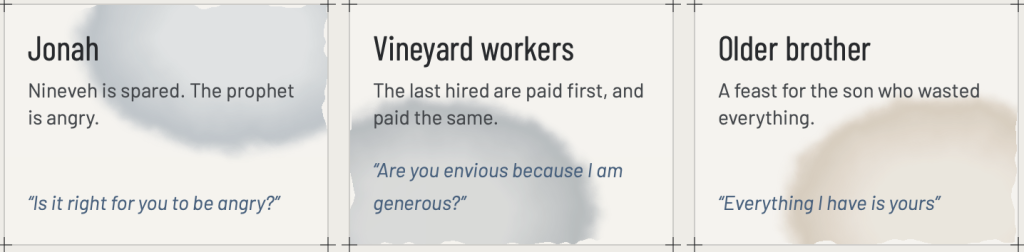
The same pattern appears in two other places in Scripture: Jonah (3:10-4:11) and the older brother in the parable of the lost son (Luke 15:25-32). In each, someone who has been “faithful” gets upset when God’s mercy reaches someone they consider undeserving.
| Aspect | Jonah 3:10-4:11 | Vineyard Workers (Matt. 20:1-16) | Older Brother (Luke 15:25-32) |
|---|---|---|---|
| Who objects | Jonah | The workers hired first | The older son |
| Who receives mercy | Nineveh | The eleventh-hour workers | The wayward younger brother |
| Who is generous | God | The landowner | The father |
| Form of mercy | Judgment withheld (3:10) | Full wage, one denarius | Welcomed home with a feast |
| Reason for complaint | Nineveh doesn’t deserve forgiveness | Those who worked less are paid the same | A reckless son is celebrated |
| The flawed perspective | Treating God’s blessing as exclusive | Comparing oneself with others | Seeing oneself as a servant, not a son |
| Key question / answer | “Is it right for you to be angry?” (4:4, 4:11) | “Are you envious because I am generous?” (20:15) | “Everything I have is yours” (15:31) |
| Who was not actually harmed | Jonah | First workers (paid what was agreed) | The older son (his inheritance is intact) |
| How the story ends | Open-ended, ends with a question | Open-ended | Open-ended |
| Core message | God’s love goes beyond national borders | Salvation is grace, not wages | We are children, not hired hands |
The most striking row is the last-but-one: all three stories end without an answer. The reader is left to decide whether to join the celebration.
God Is for Everyone
Jonah’s anger reveals something important. Israel was chosen not as a privilege to hoard but as a channel of blessing to other nations (Gen. 12:3; Isa. 49:6). Jonah forgot that, and he was upset when the blessing reached Nineveh. Peter had to learn the same thing in Acts 10:34-35.
“Universal” means the invitation is open to all, not that everyone automatically enters. Like the workers in the vineyard, people still have to respond to the call.
Jonah: A Friend Who Argues
Jonah’s relationship with God is surprisingly close. He runs away (1:3), argues openly (4:2), and even asks to die (4:3). Only someone who knows God well would dare to speak like that: he admits he knew God was gracious and compassionate, and that was exactly what frustrated him.
What stands out is God’s response. There is no punishment, only patient questions and a plant to teach him (4:6-10). Scripture seems to treat honest complaint as part of a real relationship, as with Moses, Jeremiah, Job, and the psalmists. But Jonah is still corrected. We can be honest about our feelings, and our hearts still need to be straightened out.
What About the Workplace?
Can we apply this to unfair pay at work? Carefully. Jesus uses a work scenario as a picture of the Kingdom, not as a model for payroll. Two things stand out:
- Comparison breeds resentment. The first workers had no complaint until they looked at someone else’s pay.
- The latecomers weren’t lazy. They said, “No one hired us” (v. 7). They were willing but hadn’t had the chance.
Scripture also cares about fair wages (Deut. 24:14-15; James 5:4; Col. 4:1) and about diligence (2 Thess. 3:10). Real injustice at work is still worth addressing. The parable simply teaches a heart attitude, not a pay structure.
Conclusion
Three stories ask one question: Can we rejoice when God is generous to someone else?
If we see ourselves as employees earning our place, we’ll keep counting and comparing. If we see ourselves as those who were called and welcomed by grace, we can join the feast.
A Personal Reflection: I Struggle with This Too
I’ll be honest: I get envious. When someone else receives a blessing, a break, or a celebration I was hoping for, my first reaction is often not joy. It’s a quiet, sour “what about me?”
That’s why these three stories hit close to home. Jonah, the first workers, and the older brother weren’t villains. They were faithful people, and they still struggled to rejoice when God was generous to someone else. Somehow that comforts me. Envy doesn’t mean my faith has failed. It means my heart still needs straightening out, just as Jonah’s did.
Here is what I’m learning to practice:
- Notice when the comparison starts. The first workers had no complaint until they saw someone else’s pay. When envy shows up, I ask myself: Am I actually lacking something, or am I just comparing?
- Remember what I already have. The older brother was told, “Everything I have is yours” (Luke 15:31). He was already rich and didn’t realize it. Envy tends to make me blind to what’s already been given.
- Pray for the person. It feels awkward at first, but asking God to bless the person I envy slowly changes how I see them. Romans 12:15 calls us to rejoice with those who rejoice. That takes practice; it doesn’t come naturally.
- Measure my own work. Galatians 6:4 invites us to test our own work rather than measure ourselves against someone else.
- Be honest with God. Jonah didn’t pretend to be happy. He told God exactly how he felt, and God answered with patience and questions, not punishment. “God, I’m envious” is a better prayer than silence.
Sometimes envy also points to a desire I haven’t admitted yet. Instead of only fighting it as sin, I can bring that desire to God and let Him speak to it.
So the question stays with me, and I’ll leave it with you too: Can I rejoice when God is generous to someone else? I’m not there yet. But I’d rather be honest and still learning than pretending I’ve already arrived.